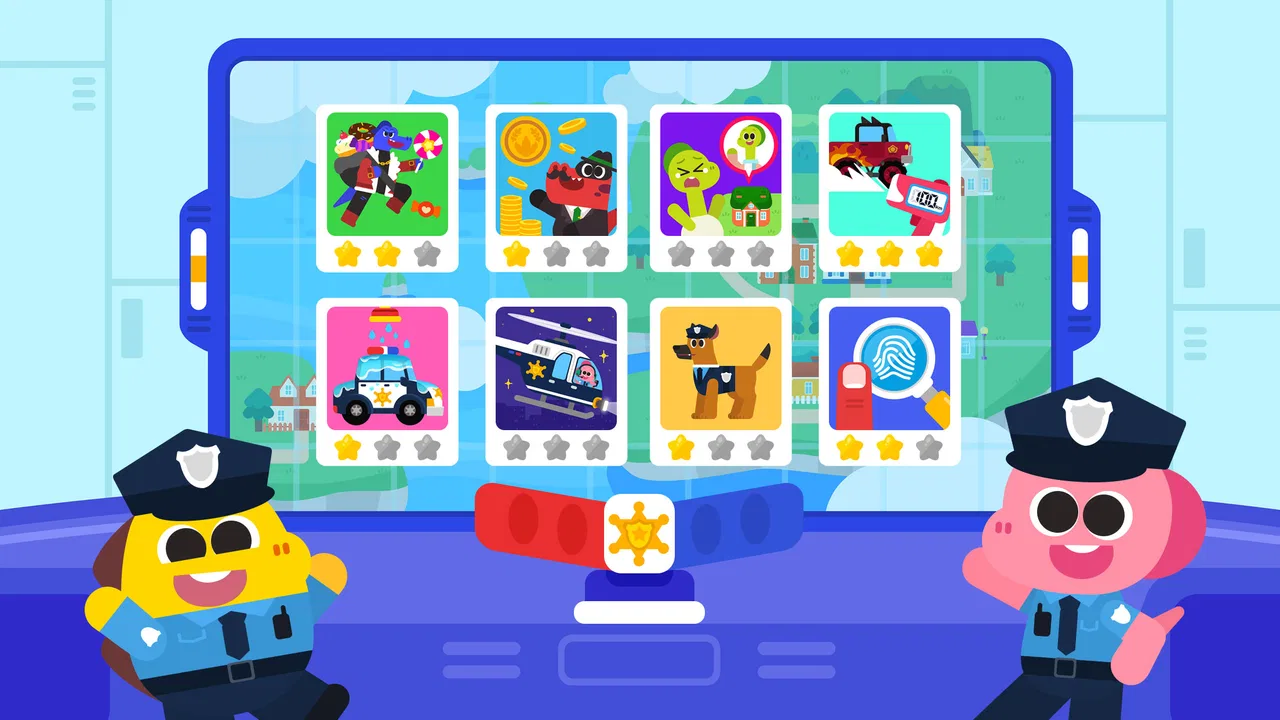
Cocobi Little Police - Kids
- 3.8
- Rating
- 10.00M
- Installs
- Free
- Price

 Analysis by App-foxy
I found Cocobi Little Police to be a friendly first step into police-themed play for young children, especially those who enjoy dinosaurs and simple missions. It is a free educational game from KIGLE, designed for Everyone and available on Android devices running at least version 7.0. The basic appeal is easy to understand: a child takes on a police role, responds to playful situations, receives immediate encouragement, and then feels ready to try another activity.
That simple loop matters more here than complexity. This is not the kind of game I would choose for a child looking for a deep adventure, a competitive challenge, or a long story. Instead, it works as a short, approachable activity that can fit into a quiet moment at home, a break during travel, or a little guided play before moving on to something else.
How the police-play loop feels in everyday use
I find the everyday appeal of the police-play loop is that a child can make a small choice, see a response, and decide whether to carry on without needing to learn a complicated system first. That makes it easier to fit into a brief quiet moment, though I’d still treat the first session as a chance to see whether the pace suits the child. From there, the most useful question is how to make those short turns feel purposeful rather than repetitive.
You May Also Like

 Blood Strike: 2.5 Anniversary
Blood Strike’s Loadouts Turn Every Drop Into a Tactical Gamble
A close look at Blood Strike’s custom loadouts: how fast access to signature weapons reshapes its battle royale rhythm, rewards preparation, and narrows the gap between fights.

 Pandora - Music & Podcasts
Pandora’s Music Is Easy to Start, but Harder to Recover
Pandora’s strength is its low-effort path from a seed to a station. Its weak spot is how much confidence it asks you to place in connection, setup, and quiet recovery.

 8 Ball Pool
 Is Built on Rivalries, Rematches, and Routine
A close look at the rivalries, rematches, shared routines, and unanswered safety questions that turn a quick pool match into a persistent mobile community.

 Samsung Music
’s Quiet Strength Is Playing What You Already Own
Its reach comes less from spectacle than from dependable access to a personal library. That simplicity is both the app’s strongest retention engine and its ceiling.

 AccuWeather: Weather Radar
AccuWeather Review: A Quick, Clear Forecast for Everyday Decisions
For everyday plans, the best forecast is the one you can understand quickly. AccuWeather makes rain timing, radar, and local conditions easy to act on, with a few trade-offs.

 Hill Climb Racing
Why Hill Climb Racing Still Turns Crashes Into One More Run
A tiny car, a bumpy hill and one more upgrade: Hill Climb Racing keeps resurfacing because its simple chaos makes every near-miss feel personal.
More From Our News Desk
View All News


The first action is easy to understand
The strongest part of the experience is how quickly a child can understand the role being offered. The police theme gives the play a clear purpose, while the dinosaur characters make it feel softer and more playful than a serious simulation. I can imagine a young player opening the game and immediately recognizing that the goal is to help, respond, and take part in small police-themed situations rather than study a complicated set of rules.
That accessibility is important for children who are still building confidence with mobile games. A complicated menu or a demanding opening sequence can make a child hand the phone back to an adult. Here, the concept itself does much of the teaching. The child does not need to understand police procedures in real life; the game presents the role as imaginative play with clear, child-friendly direction.
For parents, this makes the game easier to introduce than a large open-world title. I would still sit with a child during the first session, not because the premise is difficult, but because watching the first few interactions reveals whether the child enjoys the pace and understands what the game is asking them to do. Once that connection is made, the child can usually approach the activities with more independence.
A useful way to play is to let the child explain what the police character is doing after each action. That turns a quick tap-based activity into a small conversation about helping others, noticing details, and making choices. The game cannot replace real-world learning, but it can give parents a gentle starting point for those discussions.
Feedback keeps the next action moving
The feedback rhythm is built around the child seeing that an action has had a result. In a game aimed at young players, that response is more valuable than a complicated scoring system. If a child taps, chooses, or completes a task and receives a clear reaction, the game feels understandable. That clarity helps prevent the common frustration of not knowing whether an action worked.
I see this as the main educational strength of the experience. It encourages a basic sequence: notice what is happening, try an action, observe the response, and adjust if needed. Those are small steps, but they are exactly the kind of structure that makes an early learning game feel purposeful instead of being just a collection of colorful screens.
The dinosaur friends also help soften mistakes. A child is more likely to try again when the characters feel inviting and the atmosphere remains playful. That is a better fit for early learners than an app that treats every wrong choice as a failure. The police setting could have felt strict, but the dinosaur cast keeps the tone approachable.
There is a trade-off, though. Children who already play more advanced educational games may find the feedback too simple. Older players may want more variation between tasks, more room to plan, or a stronger sense of progress. I would judge the game by the child’s age, attention span, and previous experience rather than assuming that every child will find the same level of challenge satisfying.
Small rewards make another attempt feel worthwhile
The reward in this kind of game is not only a badge, score, or visible completion. It is also the feeling that the child helped a character and understood what to do. That emotional reward can be enough to bring a young player back for another short session, particularly when the child enjoys the dinosaur friends and the police fantasy.
I like that the theme gives the activity a reason to exist. A child is not simply pressing buttons to make animations happen; the play is framed as responding to situations and being useful. That framing can make the experience more memorable than an abstract matching exercise, even when the underlying interaction remains simple.
Parents can strengthen that reward by praising the process rather than only the outcome. Saying, “You noticed what the character needed,” is more useful than simply celebrating a successful tap. It encourages observation and patience, two habits that can carry into other educational activities.
The free price also lowers the barrier to trying it. Families can explore the game without committing to an upfront purchase, while optional in-app purchases are listed at $1.99 per item. I would recommend that an adult check the device’s purchase controls before handing it over, especially if the child plays without supervision. The important point is that the game can be tested as a free activity, but the presence of optional purchases means it should still be treated like any other child-focused mobile game.
Why the session naturally resets
After a task is completed, the child is encouraged by the sense of having finished something and can begin again with a different situation or interaction. That reset is useful because it keeps the game suitable for short bursts. A child does not need to remember a complex story or return after a long break to understand what is happening.
This makes it practical in everyday situations. If I were using it during a restaurant wait, I would prefer a game that can be paused without losing a large amount of progress. If a child has only a few minutes before bedtime, a short activity is easier to end than a game built around long missions or escalating competition.
The same reset can also become a limitation. Children who want a strong sense of long-term development may feel that each return begins from the same basic point. This is where the game differs from larger educational adventures, which often use extended stories, collections, or structured learning paths to make progress feel more permanent.
My advice is to use the reset deliberately. Rather than allowing endless automatic replay, an adult can ask the child to choose one or two activities and then describe what happened. That keeps the game from becoming background tapping and gives each session a clear beginning and ending.
The loop works best for short, guided play
Putting the pieces together, the core loop is straightforward: the child takes a police-themed action, sees an immediate response, enjoys a small sense of success, and starts another activity because the entry point remains familiar. That is a good design for preschool and early elementary players who need quick feedback and low-pressure repetition.
I would particularly recommend it to families looking for a gentle first police game, to children who respond well to dinosaur characters, and to parents who want a free title to sample before choosing a larger learning app. It can also work as a transition activity when a child needs something engaging but not overwhelmingly demanding.
I would skip it for a child who expects realistic police strategy, extensive exploration, multiplayer competition, or a detailed curriculum. It is also not the best choice if the main goal is a specific academic skill such as reading practice, arithmetic drills, or language learning. The educational value here comes more from guided interaction, understanding simple situations, and imaginative role-play than from a formal lesson structure.
What the age rating and device requirements mean
The Everyone age rating makes the game broadly suitable for family use, but age labels do not tell me whether a particular child will enjoy the controls or the pace. A very young child may still need help interpreting the screen, while an older child may move through the activities quickly and ask for more variety.
On Android, the minimum requirement is version 7.0, so the game is accessible to many older devices. That is helpful for families using a spare phone or tablet rather than a recent flagship device. I would still test it on the actual device the child will use, because screen size and touch responsiveness can affect how comfortable young hands find the interactions.
The current version is 1.0.22. I would keep the app updated through the normal device store process, particularly when an adult manages a child’s device. Updates can matter for general stability, but the more practical consideration is making sure the game opens smoothly and that purchase protections remain configured after any device changes.
How it compares with usual alternatives
Compared with a standard puzzle app, this game has a stronger imaginative frame. The child is not only solving isolated tasks; the police-and-dinosaur combination gives the actions a character-driven reason. That can be a real advantage for children who lose interest in worksheets or abstract educational games.
Compared with a large children’s adventure game, it is lighter and easier to pick up. There is less pressure to remember a story or manage a complicated world, which makes it better for short sessions. The cost of that simplicity is depth. Families seeking a longer progression system, richer exploration, or broader learning coverage may be happier with a more substantial educational platform.
Compared with a video-based children’s app, it asks the child to participate rather than simply watch. That is a meaningful difference. The child has to respond to what appears on screen, and the feedback loop gives the session a little more agency. Still, I would not treat it as a replacement for hands-on play, conversation, books, or outdoor activity. Its value is as one small interactive option among those alternatives.
Practical ways to get more from each session
One useful approach is to play beside the child at first and ask prediction questions before an action: “What do you think the police friend should do?” This adds a reasoning step that the game itself may not require. After the response, ask whether the result matched the child’s expectation. That turns the quick feedback rhythm into a simple cause-and-effect lesson.
A second approach is to use the game as a vocabulary prompt. The child can name the characters, describe the situation, and explain the action in their own words. This is especially useful when a child enjoys the theme but moves too quickly through the interactions. Talking slows the session down without making it feel like formal homework.
A third tip is to set a clear stopping point before play begins. Because the loop makes another attempt easy, a child may keep returning to the next activity. Agreeing on a small number of turns or using the completion of one chosen task as the endpoint makes the reset feel intentional rather than endless.
I would also avoid presenting the police role as a lesson in real law enforcement. The game is best understood as friendly pretend play. Adults can keep the conversation focused on helping, noticing problems, and cooperating, while making it clear that real emergencies require trusted adults and appropriate services.
Who should download it
With an average rating of 3.8 from around 2.6 thousand ratings and more than 10 million installs, the game has clearly reached a substantial audience, although those figures alone cannot predict whether it will suit a particular child. I would use them as a reason to consider it, not as proof that it is universally entertaining.
The strongest match is a young child who likes dinosaurs, enjoys pretend roles, and benefits from immediate responses. It is also a sensible option for parents who want to test a free educational game before spending money elsewhere. The low-pressure structure makes it less intimidating than many games that begin with complex instructions.
The weaker match is a child who becomes bored with repetition, wants a persistent world, or needs clearly measured academic practice. In those cases, a dedicated learning app or a more expansive adventure may provide a better reason to return. This title can support playful learning, but I would not use it as the only educational app on a device.
My final view after following the loop
I enjoyed the way the game keeps its promise small and understandable. The first action is approachable, the feedback arrives quickly, the dinosaur characters make success feel friendly, and the reset allows another short attempt without much preparation. That combination gives it a clear place in a child’s app library.
Its limitations are equally clear: the experience is not built for deep strategy, formal subject teaching, or long-term progression. Parents should also remember that optional purchases cost $1.99 per item and should set device controls accordingly. Those points do not ruin the experience, but they shape how I would recommend using it.
My recommendation is to try it as a supervised, short-session activity rather than expecting a complete learning program. If your child enjoys the police theme and dinosaur characters, the repeated action-feedback-reward-reset cycle can be genuinely engaging. If your child needs substantial challenge or a detailed educational path, I would choose a more specialized alternative. For the right age and mood, however, Cocobi Little Police is a cheerful way to turn a few spare minutes into simple imaginative play.
FAQs for Cocobi Little Police - Kids
01What is Cocobi Little Police - Kids?
Cocobi Little Police - Kids is an interactive educational game designed for young children. Players join the Cocobi characters as police officers and help solve simple community problems, respond to emergencies, and complete friendly missions. The gameplay uses colorful scenes, short activities, and easy controls, making it approachable for preschoolers who enjoy role-play and learning through play.
02Is Cocobi Little Police - Kids suitable for my child’s age?
The game is mainly aimed at preschool and early-school-age children, although the ideal age may vary depending on the child’s reading ability and familiarity with mobile games. Most activities are simple and visually guided, so children can often play independently after a short introduction. Parents should still check the store’s current age rating and observe whether the content matches their child’s maturity.
03Does the game require an internet connection to play?
Many parts of Cocobi Little Police - Kids may be playable without a constant internet connection once the application has been installed, which is convenient for travel or limited-data situations. However, an internet connection may still be needed for downloading the game, receiving updates, restoring purchases, or displaying optional advertisements. Availability can differ by device and app version.
04Does Cocobi Little Police - Kids contain ads or in-app purchases?
The game may include advertising, optional purchases, or both, depending on the version, platform, region, and settings on your device. Since children can tap buttons accidentally, parents should review the app store purchase controls and use device-level parental restrictions before handing over the phone or tablet. Always check the current store listing for the latest payment information.
05What can children learn or practice while playing?
Cocobi Little Police - Kids focuses primarily on imaginative play, but its activities can also encourage observation, decision-making, following instructions, and basic problem-solving. Children practice recognizing situations, choosing appropriate actions, and completing simple tasks in a playful setting. It should not be treated as formal safety training, however, and younger children may benefit from discussing the missions with an adult.
Pros
- Simple controls make it easy for young children to play independently.
- Police-themed missions encourage helpfulness
- safety
- and problem-solving.
- Bright visuals and friendly characters are appealing to preschoolers.
- Short activities suit children with limited attention spans.
- Works well as a gentle
- non-competitive introduction to mobile games.
Cons
- Gameplay may feel repetitive after children complete the available missions.
- Some features or content may require in-app purchases.
- The app can take considerable storage space on older devices.
- Younger children may still need help understanding certain objectives.
- Ads or promotional elements may distract from play
- depending on the version.

Cocobi Little Police - Kids
Gallery